Page 43
And yet.
If anyone glanced out and saw them half-hidden among the roses—
She could be compromised.
Her mind sketched the two possible outcomes with horrifying clarity:




A) Someone gasps, someone whispers, and she is ruined. No husband, no pâtisserie, no Pepper—only the broken shell of Lady Barbara’s scandal.
B) Someone gasps, someone whispers, and she is pushed into marrying the handsome man who likes her pastries, listens when she talks of flour, and looks at her as if she were more than half a person. A duke whose mother would count heirs the way other women counted stitches. A husband who would expect a sound wife, not a girl whose childhood fever might still make childbed dangerous. A life in which Pepper vanished and only Her Grace remained.
From the outside, option B would look like a fairy tale. From inside her own bones, it looked like a bargain struck with bars: Papa’s shop and his hope of a Royal Warrant traded for ballrooms, babies she might never safely bear, and a husband who could not possibly love both the lady and the baker she refused to stop being. She could not decide which future frightened her more. Pepper smoothed her hand down her shawl and lifted her chin. “I suppose so,” she said. “If it is not about lopsided pastries.”
That startled a soft laugh out of him. “It is not,” he said.
“Wise,” she murmured.
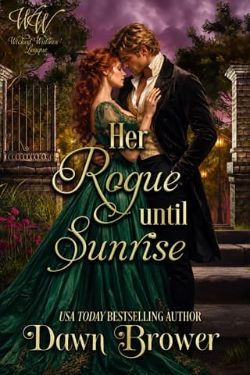
His smile faded; his gaze sharpened. Up close, in the rose-scented half-light, he was almost disconcertingly easy to look at. The navy of his coat was so precise it might have offended her—if it weren’t for the tiny imperfection near his jaw where a razor had missed and a faint shadow showed. His cravat was immaculate; his hair did exactly what it ought. But it was his eyes that undid her.
Gray, clear, intent. The look of a man who noticed things and kept noticing even when it was inconvenient.
“Why,” he asked gently, “is the bakery worth risking so much for?”
The question dropped into her like a stone into a well.
This was why she could not be alone with him. Other men teased, or boasted, or spoke of weather. Chester asked the thing she hid even from herself if she could help it.
An answer leapt to mind that was not fit for a duke: Because Wyndale’s ink strangled our credit and someone has to keep the ovens breathing when men in London draw lines on paper. Because Papa coughs over the bills, and if the pâtisserie fails, it will not be a line in a ledger for him; it will be the end of everything he built. And then Mama can’t ever know Papa is in London and they won’t ever be together and I… no, this was too much to package into a conversation with a stranger, no matter how handsome he was.
She swallowed that back.
“You say ‘risk’ as if I were smuggling contraband,” she managed, aiming for airy.
“Aren’t you?” he said. “You smuggle yourself, every day. Out of one life and into another. Lady Barbara in this house, Pepper in a bakery. You keep those boots hidden under silk in drawing rooms and walk into flour dust in boots. You defy your mother, a little, and Society, a lot.”
His gaze dipped—briefly, respectfully—to her feet, then returned to her face.
“That seems…a great deal, for pastry,” he finished.




For my father. For my whole self. For the only place I am not damaged goods.
She stared past his shoulder at the dark hedge. “It is complicated,” she said. “And very dull. You would be disappointed, I promise you.”
“I doubt that you could ever be dull or disappoint me,” he said quietly. “But very well. If you refuse the truth, you leave me only one recourse.”
She blinked. “Which is?”
“Speculation,” he said. “Wild and unfounded. There can be no reasonable explanation, so I must try unreasonable ones.”
Despite herself, she felt her mouth twitch. “Indulge, then,” she said. “I shall evaluate your efforts.”
He pressed a hand to his chest. “I quake. Very well. The first theory:[AR19] you are a Russian spy.”
She choked. “Obviously,” she said faintly. His wild imagination was amusing.
“How else,” he went on, grave as a judge, “do we explain a well-bred lady haunting a pâtisserie every afternoon? Code-books baked into loaves. Secret messages in marmalade. Sugar violets as signals—one crunch for yes, two for no. It’s all very suspicious.”
She turned fully toward him now, unable to help it. The lantern-light carved his cheekbones into sharper planes and put a mischievous glint in his eyes.