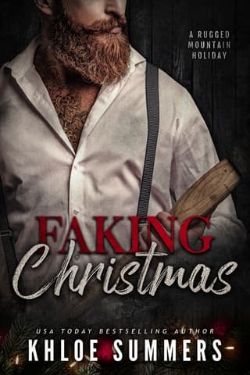
Mountain Man’s Christmas Stalking
Page 3
“The cranberry-orange Danish. My mother’s recipe, though I do most of the baking now.” He pointed with a gloved finger. “Or the maple-pecan roll if you want something that will make you regret wearing a fitted coat.”
I considered the options. I’d eaten a quick breakfast before driving up from Denver, but that had been hours ago. “One of each, please. Apparently I make poor decisions around pastry.”
“Those are excellent decisions.” He slid both into a paper bag and added a napkin. “Visiting for Christmas?”
“Working here for a few days. I used to live in town, though it’s been a long time.”




“Then welcome back. You picked the best week to return.” Sean’s expression brightened as he handed me the bag. “My parents used to come up from Denver every Christmas before I was born. They always said they wanted to live here, and they finally moved when I was still a baby. I don’t remember any of it.”
There it was: the Denver-to-Promise-Ridge timeline the initial file had suggested. It gave me a better idea of where to look next.
“Your family must’ve been busy opening the bakery with a baby in tow,” I said.
“Oh, they were. Mom still tells the story about Dad trying to install a display case while I slept in a carrier behind the counter. I think it’s her favorite excuse for why he isn’t allowed to fix anything himself anymore.” Sean chuckled and glanced toward the growing line. “Enjoy those. If you’re in town tomorrow, I’ll try to save you a cinnamon twist.”
“I’d appreciate that. Thanks.”
I paid and moved out of the way. A customer with three children had taken my place, and Sean was already describing which cookies contained nuts. His easy manner and family stories gave me a useful starting point. The newspaper archive Virginia had sent might tell me more.
I found a bench along the edge of the square and took a bite of the Danish. The pastry flaked across my gloves, leaving a bright smear of cranberry filling on the napkin. Sean hadn’t been exaggerating. The filling was tart, the orange glaze sweet, and the butter had soaked into every delicate layer.
I was halfway through it when an engine rumbled into the delivery space on the east side of the square.
The pickup was an older model, painted a deep red that stood out against the snow. Its cab shone with fresh polish, but the rear fender wore a slightly different shade of paint. Wreaths and bundled evergreen garlands filled the bed. A man eased it into the loading space, climbed out and walked around to release the straps securing the greenery.
For a second, I noticed only the truck. Gordon Fraser had owned one much like it when I was a teenager, and I’d spent plenty of evenings riding in the passenger seat while his oldest son drove us to the diner or out to the overlook.
Then the driver straightened, and I forgot about the pastry in my hand.
It was Joe Fraser.
I had seen recent pictures in his candidate file. They hadn’t prepared me for the sight of him moving across the square with the same easy confidence he’d had at nineteen, now packed into a body that made the man in those old memories seem almost slight. He had to be six-three, with broad shoulders filling out a dark winter coat and muscular thighs beneath worn jeans. Dark-brown hair brushed his collar, and a full beard framed a face that was older, stronger and devastatingly familiar.
Joseph Fraser had grown into a mountain man in the most literal, unfairly attractive sense of the phrase.
He lifted a bundle of garland from the truck and carried it toward a town worker waiting beside the tree. Even through layers of winter clothing, I recognized the purposeful way he moved. The two men talked for a minute, then Joe pointed toward the branches overhanging the square’s main walkway. He wasn’t posing beside his family’s tree for a holiday photograph. He was working.
I lowered the Danish to my lap before I could drop it.




When we’d been teenagers, Joe had kissed me behind the school gym after a winter dance, one hand warm against the back of my neck while snow gathered in our hair. I’d spent the rest of that night imagining what it would be like when we were grown and no one could tell us when to be home. Apparently my imagination had been wildly conservative.
He finished speaking to the worker and turned to fetch another bundle. His gaze passed over the crowd, paused, and came straight back to me.
For a moment neither of us moved.
Then Joe smiled, slow and disbelieving, and headed in my direction.
I stood, brushing crumbs from the front of my coat. My pulse had picked up, and I was suddenly conscious of the wind tugging loose strands of hair across my face. Of all the people I might have encountered during a straightforward field assignment, this was the one who could make me feel sixteen and thoroughly grown-up at the same time.
“Ivy Whitaker?” His voice was deeper than I remembered, with a rough warmth that carried easily over the music and crowd. “I thought that was you, but I had to look twice.”
“The beard threw me,” I said. “You didn’t have nearly that much of it last time.”
He laughed and rubbed one hand over his jaw. “I’ve had a few years to work on it. How long has it been?”
“About eleven years since I moved. A little less since we last saw each other.”
One of the town workers waved Joe over to ask where the extra garlands should go. He walked halfway to the truck, directed the man to the remaining bundles in the bed, then returned to me rather than going back to the delivery.